
Co-Living for Entrepreneurs and Founders: Environment Shapes What You Build
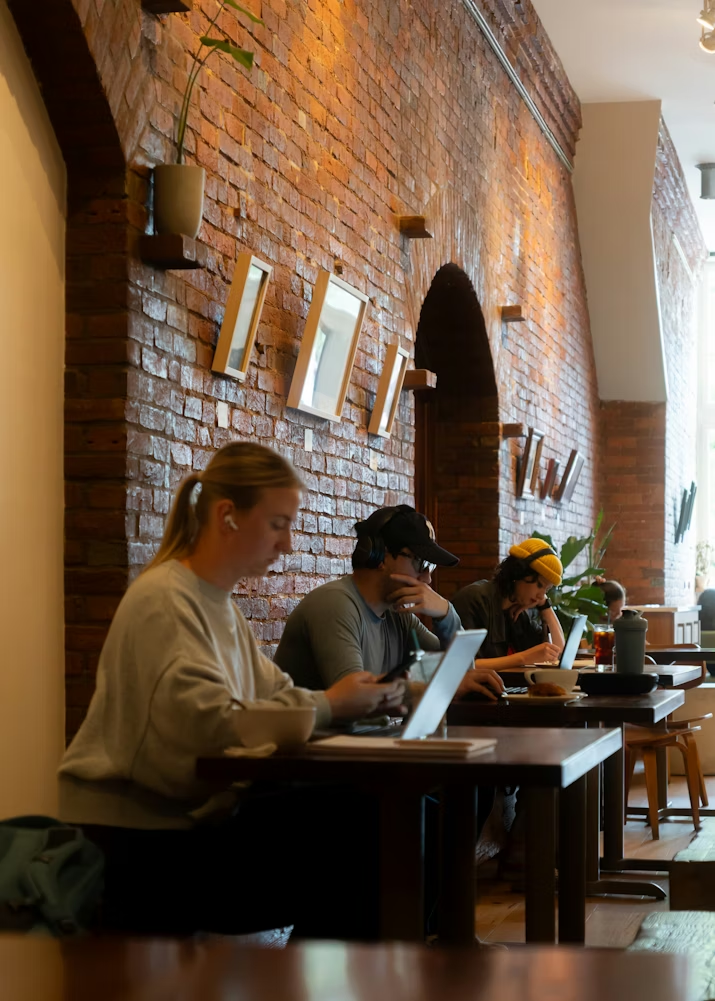
There’s a body of research on how environments shape cognition — on how noise levels, natural light, and social context affect decision quality, creativity, and sustained focus. Most founders know this intuitively. They’ve experienced how the right environment — the right combination of space, quiet, stimulation, and conversation — produces different thinking than the wrong one.
They’ve also experienced, often painfully, how hard that environment is to maintain. The home office that becomes a trap. The open-plan office that makes deep work impossible. The co-working space that provides infrastructure but no community. The isolation of remote work without community.
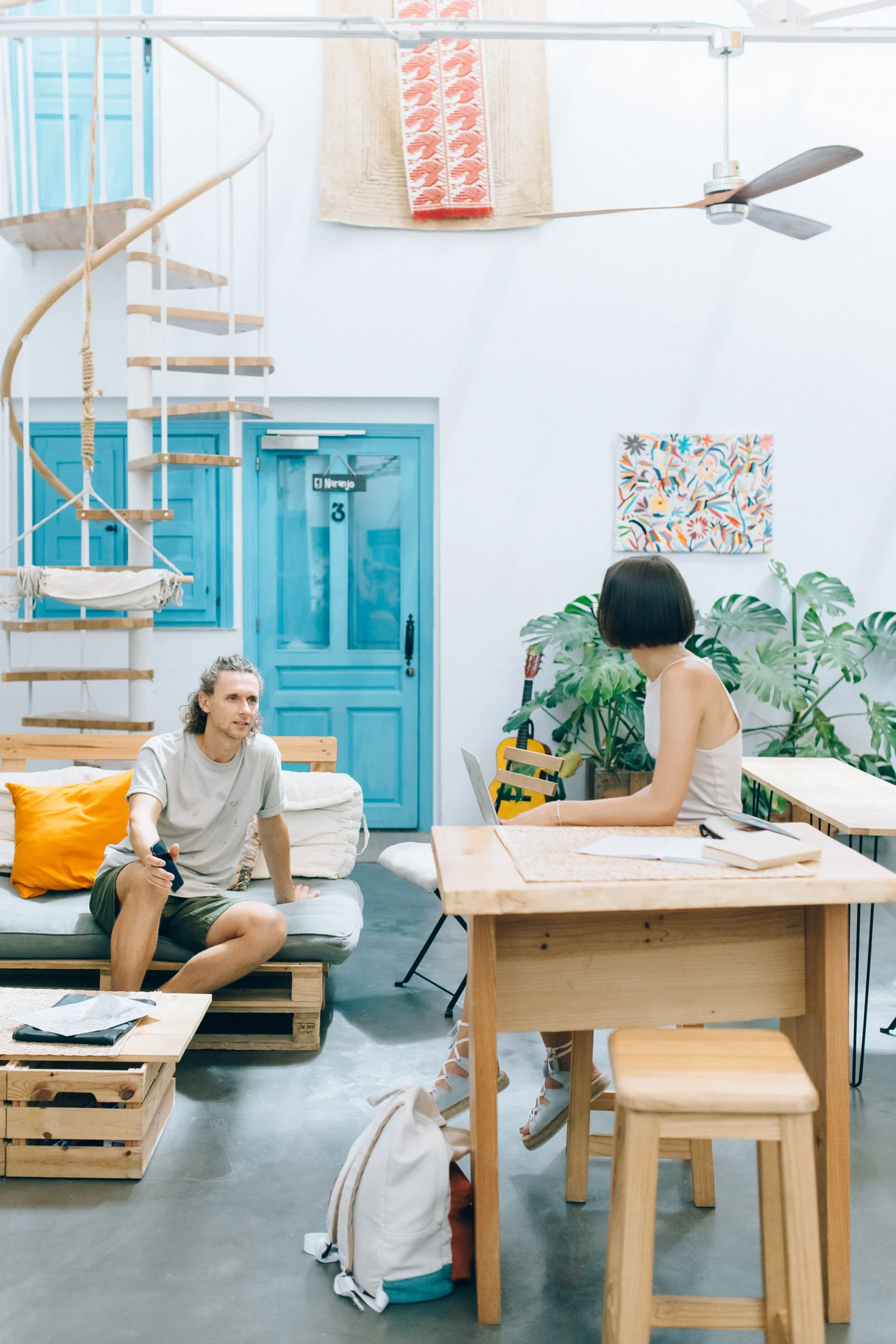
Co-living for entrepreneurs addresses this problem structurally rather than individually. Instead of trying to engineer your ideal environment from scratch each time, you choose an environment already designed for the kind of work you’re trying to do.
What Founders Specifically Need From a Work Environment
Founders have distinct requirements that co-working or regular co-living often fails to meet:
High-quality focus time. Not the productivity-hack version — the ability to be genuinely, deeply engaged with a hard problem for 4–6 hours. This requires quietness, no notifications, and a space that has been set up to support focus rather than distraction.
Serendipitous high-quality conversation. The casual encounters that turn into breakthroughs. Bumping into someone at dinner who happens to know the exact thing you’re stuck on. The adjacent discipline that solves your problem by analogy. This only happens in communities with genuine intellectual density.
Space for strategic thinking. The specific kind of thinking that founders most often fail to give enough time to — not executing on the to-do list but stepping back from it. What problem are you actually solving? What would make this irrelevant? What are you optimizing for and why? This requires real mental space, which standard working environments often don’t provide.
Peer accountability without hierarchy. Other founders at roughly similar stages — people who understand the specific pressure you’re under, who can give useful feedback, and with whom you can be honest about what’s not working. The isolation of being the only person who can’t offload your problems upward is real; other founders in the same position provide genuine counterweight.
Access to nature and restorative environments. Founders who burn out uniformly report that they had no recovery environment — nowhere that genuinely restored them rather than just pausing them. A co-living in a beautiful natural setting isn’t a luxury; it’s maintenance.
What Standard Co-Living Gets Wrong for Founders
Most co-living products are optimized for digital nomads — people who need a desk, wifi, and some social life around their remote work. This works fine for that use case. For founders trying to build something serious, it often falls short.
The shallow community problem. A high-turnover co-living community — weekly new arrivals, constant introductory conversations, relationships that never develop past “what do you do?” — provides social contact but not intellectual community. Founders need the latter.
The infrastructure-over-substance problem. Speed of wifi, number of monitors available, meeting room booking system — these matter, but they’re not what actually makes a founder’s year better. The environment that shapes what you build is made of conversations, community norms, the quality of shared time.
The always-on social dynamic. Some co-living environments create subtle pressure toward constant availability — communal meals that feel mandatory, social schedules that crowd out deep work. For founders who need to protect significant blocks of uninterrupted time, this is structurally hostile.
What Good Co-Living for Founders Looks Like
Curated community density. Small enough to actually know everyone; diverse enough to have genuine intellectual range. The co-living that has 8 founders, 6 creatives, and 4 builders of various kinds creates more useful serendipity than 20 people who all do SaaS marketing.
Real time for deep work. Long, protected morning blocks. Norms that make focus time a genuine option rather than a fight for quiet. Workspaces designed for sustained engagement rather than short bursts.
Strategic reflection infrastructure. This sounds vague but is concrete in practice: a community that has discussions about what you’re building and why (not just how), events structured around strategic questions (not just skill-shares), and facilitators who can help groups think about direction rather than just execution.
Nature access. This isn’t decorative. The research on cognitive restoration — the ability of natural environments to replenish attention and reduce mental fatigue — is robust. A co-living in a farmstay, a forest, or on the coast provides something that a city coworking space structurally cannot.
Long enough to matter. The best co-living for founders has minimum stays of 2–4 weeks, not 3 days. Real community and real work depth both require time.
Vietnam as a Context for Founder Co-Living
Why Vietnam specifically? A few converging reasons:
The cost arbitrage is real. A good co-living in Vietnam costs $600–900/month. The equivalent environment in Bali or Lisbon costs $1,500–2,500. The savings fund 6–12 more months of runway. This is not a minor consideration.
The climate is conducive to sustained work. The general warmth, the ability to work outdoors in the morning, the natural light — these are working conditions that cold northern European or American cities don’t provide.
The distance creates useful perspective. Founders who go to Vietnam specifically often report a shift in perspective about their business — partly from the distance from their home context, partly from the particular quality of attention that comes from being somewhere genuinely different.
The culture asks good questions. Vietnam’s recent history — rapid economic transformation, a living relationship between tradition and modernity, deep uncertainty successfully navigated — creates ambient questions about change, adaptation, and what matters. These are useful questions for founders to sit with.
A Framework for Choosing a Founder Co-Living
If you’re evaluating a co-living as a founder, here are the questions that matter more than wifi speed:
-
Who is the community, and what are they building? Ask for resident profiles or alumni descriptions. “Entrepreneurs and creatives” is a category; knowing that they’ve hosted a specific type of person tells you whether the community fits.
-
What’s the minimum stay, and what does the typical resident stay? Short minimum = high turnover = shallow community. If most residents leave in a week, the community is a series of introductions.
-
What’s the programming? Events designed for strategic thinking, founder challenges, and serious intellectual exchange — or parties and skill-shares?
-
What is the deep work policy? Are there quiet spaces? Protected morning hours? Is the general culture one where people make space for each other to think?
-
What do alumni say? Talk to people who’ve stayed. The marketing describes the aspiration; alumni describe the reality.
The Environment Shapes What You Build
This is the headline of this post, and it’s worth taking seriously rather than treating as metaphor.
The environment you work in shapes what you’re exposed to, what you think about, what you normalize, what you aspire to, and who you become. This is true for everyone but especially true for founders, whose primary resource is their own judgment and whose job is to think clearly under uncertainty.
An environment designed for the kind of work you’re doing — with the community, the space, the rhythms, and the natural setting that support it — is a direct investment in your primary resource.
NextU is building co-living in Vietnam with founders and creative builders as one of the primary communities. Join the waitlist — locations opening in 2026.
→ What Is Conscious Co-Living?
→ Co-Living vs Renting an Apartment in Vietnam
→ Slow Living in Vietnam