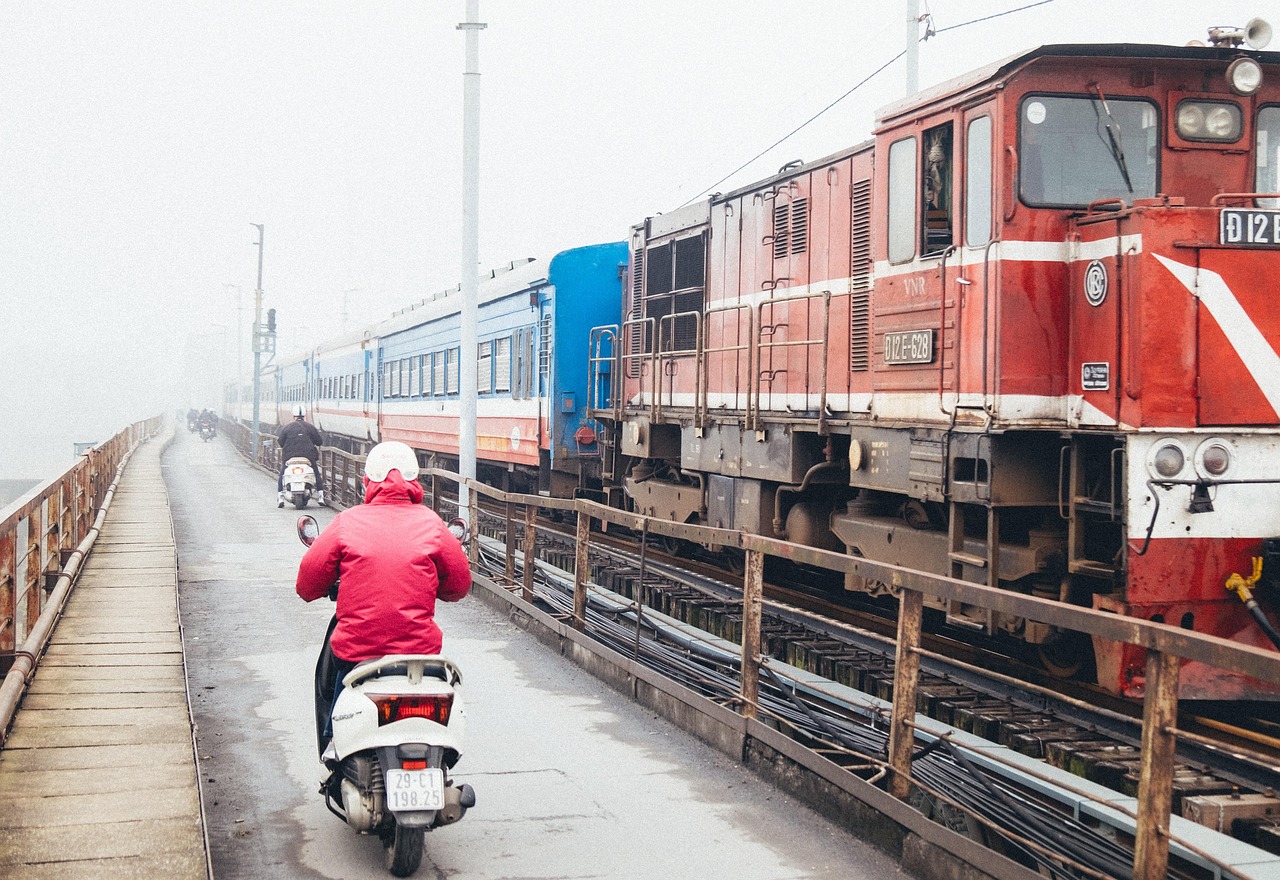
Vietnam is long and thin, which makes it one of the best-shaped countries in the world for train travel. A single line runs roughly 1,700 kilometres from Hanoi to Ho Chi Minh City, threading through nearly every place a slow traveller would want to stop.
Flying is faster and often cheaper. Buses are cheaper still. The train wins on everything else — comfort, legroom, scenery, and the fact that you arrive in the middle of a city rather than at an airport an hour outside it.
What the line actually connects
The main north–south route links Hanoi, Ninh Binh, Dong Hoi (for Phong Nha), Hue, Da Nang, Nha Trang and Ho Chi Minh City, with plenty of smaller stops between. Branch lines run from Hanoi toward the northern border, including the overnight service used to reach Sapa.
Between them, those stations cover most of Ninh Binh, Hue, Phong Nha, Nha Trang and the major cities — which is to say, you can build an entire Vietnam itinerary on rails.
The classes, and which to book
- Soft sleeper, four berths. The default recommendation. Air conditioned, a proper mattress, a door that closes, and three companions rather than five. Lower berths cost more and are worth it — you get to sit up and see out.
- Soft sleeper, six berths. Cheaper, more crowded, and the top bunk is a long way up with limited headroom.
- Soft seat. Fine for daytime legs of a few hours. Reclining, air conditioned, and much better than the equivalent bus.
- Hard seat. Cheap and uncomfortable. Only for short hops.
Newer refurbished carriages and privately operated cabins run on some routes and are noticeably nicer for a modest premium. On overnight legs, the sleeper is the point — you convert a travel day into a night’s sleep, which is the strongest practical argument for the whole approach.
The stretch worth planning around
The coastal run between Hue and Da Nang is one of the great train journeys in Asia. The line clings to the mountainside around the Hai Van Pass, with the sea directly below on one side and jungle rising on the other, and there is no road view that matches it.
It takes about three hours and it is worth arranging your itinerary so you do this leg in daylight, sitting on the sea side. If you take only one train in Vietnam, take this one.

Booking
Tickets can be bought at stations, through agents, and online. Book several days ahead for sleepers on popular routes, and considerably further ahead around public holidays — during Tet the entire network sells out and prices rise sharply.
Bring your passport; it is needed for booking and sometimes checked on board. Note that station names do not always match the city name you expect, so confirm which station you actually want before buying.
What it is like on board
Cleaner and calmer than most first-timers expect. Bedding is provided in sleepers. There is a restaurant car and a trolley service, though the food is unremarkable — bring your own, as everyone else does. Vietnamese families travel with impressive supplies and will frequently offer you some, which is one of the better things about the experience.
Power sockets exist in most sleeper cabins but are limited and unreliable; bring a power bank. Mobile data works for most of the route with gaps through the mountains, so a train is a reasonable place to work through a backlog but a poor place to schedule a call. See our connectivity guide.
Train versus bus versus plane
Sleeper buses are cheaper and faster on some routes, and they are genuinely unpleasant — cramped berths, aggressive driving, and arrival at four in the morning at a station outside town. Domestic flights are cheap and quick but cost you a half-day in transfers and security either side.
The train is the middle option that costs you time and gives you back comfort and scenery. Our transport guide compares all three properly.
Why it suits the way we travel
Trains reward the version of travel where you are not in a hurry. If you are moving between two bases every few weeks rather than sprinting through eight cities, the overnight sleeper stops being a compromise and becomes the most sensible link in the chain — you go to bed in one city and wake up in another with the day intact.
That is the pattern staying 30 days instead of 3 argues for, and it is how NextU’s network of locations is designed to be used — a few real bases connected by slow travel rather than a constant scramble. The membership page explains how moving between them works.